


Vowing to protect their land, dozens of residents from New Taipei City’s (新北市) Gongliao District (貢寮) yesterday protested a government land seizure plan to make room for a development project in the coastal area.
“We, the people of Gongliao, have lived there for hundreds, or even thousands of years as the indigenous Ketagalan tribe — we are not giving up the land that’s been passed down from our ancestors,” Lin Sheng-yi (林勝義), a native of Gongliao, told a news conference at the Legislative Yuan in Taipei.
“The Construction and Planning Agency [CPA] is collaborating with big corporations to take over our land — they have no right to seize our land by force,” he said.
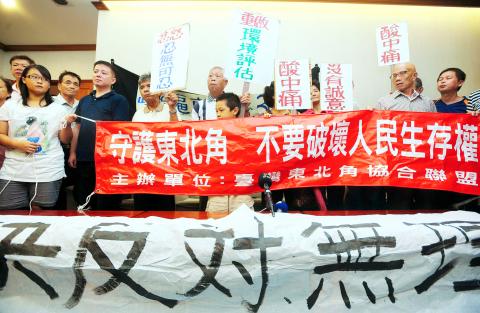
Photo: Wang Yi-sung, Taipei Times
Lin, who is a descendent of the Ketagalan Aboriginal people that inhabited Gongliao and most of the Greater Taipei area before Han immigrants from China arrived in Taiwan, said the people of Gongliao had already suffered when plots of their land were taken over by the government decades ago for the construction of the Fourth Nuclear Power Plant.
“We’re not going to allow this to happen again,” Lin said.
According to an official document detailing the project released by the CPA, there are 11 project sites in Gongliao with a total area of 102.56 hectares. The different sites would be turned into commercial, residential and hotel zones.
Chien Fung-jung (簡豐榮), president of Hemei Community Development Association, accused the government of trying to destroy the village by taking over the best farmlands in the community.
“According to the government’s plans, they would take over 40 hectares of the best flat land in the village and turn it into hotels and residential complexes,” Chien said. “After the planned expropriation, only land on the hills that is not arable would be left to us. We cannot grow anything there, the villagers would be forced to leave and the village would be dead.”
The most common agricultural produce in Gongliao includes rice, watermelon and green asparagus — all cultivated on flat land.
Goo Tshun-jiong (吳春蓉), a member of the Taiwan Northeast Coast Concord Alliance, said it did not make sense to build commercial and residential districts in the area, since some of the sites are very close to the Fourth Nuclear Power Plant.
“The CPA says that it is trying to bring about 9,500 residents into the area, but all the sites [they want] are in the area surrounding the nuclear power plant. Who would want to live next to a nuclear power plant?” Goo asked.
“And isn’t it in the safety handbook that nuclear power plants should be built in low-density areas away from residential neighborhoods?” she added.
Gongliao is a tourist attraction for its landscape, hiking trails in the mountains and beach, Goo said, adding that “urbanization as the CPA plans to do is not suitable for Gongliao, because it would turn it into just another ordinary small city without character.”
“If the government really cares about Gongliao’s development, it should tailor-make a plan for Gongliao, with the participation of all residents,” she said.
“So far, residents have never been consulted in the process of planning such development projects,” she added.
Goo called on the CPA to suspend the development project until it had held negotiations with local residents and farmers.

UPGRADE: The Kang Ding-class frigate is replacing its Chaparall missiles with Tien Chien II and Hua Yang VLS, which would provide it with long-range, 360° air defense Taiwan plans to produce 1,200 to 1,376 Hai Chien II missiles (海劍二, Sea Sword II) — also known as TC-2N — to serve as the standard air defense system of the navy’s surface combatant fleet, a source said yesterday. Last week, the Hai Chien II, the naval version of the Tien Kung II missile (天劍二, Sky Sword II), completed a live-fire test in waters off the National Chungshan Institute of Science and Technology’s Jiupeng facility (九鵬) in Pingtung County’s Manjhou Township (滿州). The MIM72 Chaparral and other dated air defense missiles that currently arm Taiwanese ships have inadequate range to combat Chinese

REASONS FOR TRAVEL: An assistant professor said that proposed amendments to penalize drivers if they used drugs overseas would not deter people from traveling People who operate a motor vehicle under the influence of marijuana would have their driver’s license revoked, even if they used the substance while overseas, the Ministry of Transportation and Communications said yesterday, citing proposed amendments to the Road Traffic Management and Penalty Act (道路交通管理處罰條例). The amendments would also authorize the government to revoke the licenses of people determined to have used Category 1 or Category 2 narcotics, even if they were not operating a vehicle while under the influence of drugs, as well as ban them from taking the license test for three years, the ministry said. People aged 18 or

HEAVY WEATHER: Typhoon Jangmi is due to crash straight into the Ryukyus as airlines look to shift flights to larger aircraft or cancel flights to Okinawa entirely Taiwan’s international air carriers announced flight adjustments over the weekend as Typhoon Jangmi is forecast to hit the Ryukyu Islands today and tomorrow. The Central Weather Administration (CWA) upgraded Jangmi from a tropical storm to a typhoon at 8am yesterday, with the eye located 580km south of Naha city. It was moving north at 19kph. Today, China Airlines’ CI-120, CI-121, CI-122 and CI-123 flights between Taoyuan and Naha, Okinawa, have been canceled as well as CI-132 and CI-133 between Kaohsiung and Naha. EVA Air’s BR-112, BR-113, BR-186 and BR-185 flights between Taoyuan and Naha are also canceled. Low-cost carrier Tigerair Taiwan canceled IT-230,
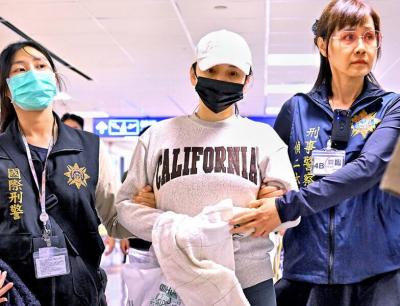
Johanne Liou (劉喬安), a Taiwanese woman who shot to unwanted fame during the Sunflower movement protests in 2014, returned to Taiwan last night after being deported from the US. She is to stand trial in Taiwan for charges involving embezzlement, fraud and drug crimes. The Criminal Investigation Bureau (CIB) said it took her into custody at Taiwan Taoyuan International Airport and would first question her before transferring her to the New Taipei District Prosecutors’ Office. She was arrested upon disembarking a flight from San Francisco that landed shortly before 7pm. Liou absconded to the US in 2019 after jumping bail


 RSS
RSS